• The ceasefire’s arithmetic: when politics meets petroleum flows

    The point

    A two-week US-Iran ceasefire holds while Israel bombs Lebanon and threatens to collapse the arrangement before it stabilizes. The contradiction isn’t diplomatic but material: Trump needs Hormuz open to contain inflation, Netanyahu needs the war to continue for domestic survival, and Europe’s industrial base hangs in the balance. The ceasefire emerged not from goodwill but from energy arithmetic — with 29.6 million barrels per day still trapped behind Hormuz, and IMF projections showing global growth dragging toward recession if the blockade persists [RAG-2].

    Ceasefire architecture under strain

    Israel tests the boundaries while Washington calculates costs

    Netanyahu announced readiness for direct talks with Lebanon “as soon as possible” while IDF strikes killed 303 Lebanese civilians Wednesday alone (Middle East Eye). The logic is transparent: keep the regional war simmering below the threshold that would force Trump to choose between his ceasefire with Iran and his support for Israel. Hezbollah lawmaker Ali Fayyad rejected direct negotiations, insisting any talks must include Iran — which exposes the fundamental contradiction in Trump’s approach (Middle East Eye).

    Democratic lawmakers warned the White House that continued Israeli bombing could “reignite the regional war” (Al Jazeera). But the real constraint isn’t Congressional pressure — it’s the energy infrastructure still burning in the Gulf. Iran’s deputy foreign minister told BBC that Israeli strikes constitute a “grave violation” and the US must choose between “war and ceasefire.” The choice isn’t moral but mathematical: with refining capacity at Abqaiq, Kharg Island, and Fujairah still damaged, any return to full conflict would push oil toward $200 per barrel [RAG-5,RAG-6,RAG-7].

    The first non-Iranian tanker crossed Hormuz since the ceasefire — a Gabon-flagged vessel heading to India (ANSA). This single ship represents more than symbolic progress: it tests whether Iran will honor the arrangement when Israeli strikes continue in Lebanon. Tehran claims victory while its population fears increased domestic repression (Deutsche Welle). The regime survived but emerged wounded, creating pressure for internal consolidation that could destabilize the ceasefire from within.

    Negotiations begin with asymmetric leverage

    Direct Israel-Lebanon talks will start next week at the State Department, according to Axios sources (ANSA). Lebanon seeks a ceasefire before negotiations begin, while Israel demands Hezbollah disarmament as the starting point. This sequencing dispute reveals the deeper dynamic: Netanyahu needs ongoing conflict to justify his political survival, while Lebanon’s government — bankrupt and dependent on external financing — cannot afford prolonged war.

    The IMF’s Kristalina Georgieva warned that the Iran war “could lead to another bout of inflation and higher interest rates” (NYT). With current damages alone, the crisis index reaches 71 by December 2026 even without new escalation [RAG-2]. Trump’s optimism about Iran deals being “within reach” (NBC interview, ANSA) reflects this constraint: his domestic economic agenda depends on energy price stability, creating leverage for Iran that doesn’t exist on the battlefield.

    Industrial retreat accelerates

    European manufacturing adjusts to new energy realities

    Volkswagen will end EV production at its Tennessee plant, scaling back electric vehicle plans in favor of gasoline models (NYT). This reversal, framed as market preference, actually reflects supply chain disruption from the Gulf crisis. Lithium processing requires massive energy inputs, and European manufacturers face input costs that make EV production uncompetitive with Chinese alternatives.

    Trump threatened 20% tariffs on European cars unless the EU removes trade barriers “soon” (SCMP). The timing links directly to the energy crisis: European manufacturers, facing higher production costs from disrupted Gulf energy flows, cannot compete on price with US production. The tariff threat provides cover for an industrial restructuring already underway due to material conditions.

    Italy’s 10-year bond spread with Germany closed down to 74 basis points, with energy stocks driving Milan’s positive close (ANSA). This market movement reflects expectations that the ceasefire will hold long enough to restart Gulf production. But the arithmetic remains stark: Europe imports 15% of its oil through Hormuz, making it vulnerable to any resumption of conflict [RAG-4].

    Economy & Markets

    Oil markets show cautious stabilization but haven’t fully priced the fragility of current arrangements. Brent crude remains elevated as traders calculate ceasefire durability against infrastructure damage that will take months to repair. European gas prices declined on pipeline supply security, but LNG routes remain constrained with 23.2% of global capacity still affected [RAG-2].

    Italian BTPs outperformed German Bunds as energy sector strength drove Milan higher. ENI and Leonardo led gains, reflecting market expectations of Gulf production resumption. But the 74 basis point spread still prices significant political risk premium.

    The first Hormuz crossing by a non-Iranian tanker provides concrete evidence the waterway is reopening, but single-digit vessel counts remain far below the normal 40+ daily transits required for global energy security.

    Weak signals

    Universal Music Group faces a €55 billion bid from hedge fund manager Bill Ackman, highlighting how energy crisis capital seeks stable revenue streams in entertainment assets while manufacturing faces input cost pressures (Financial Times).

    LA28 Olympics ticket sales exceeded all previous domestic demand, suggesting American consumer confidence remains strong despite geopolitical tensions — or perhaps because of expectation that conflicts will resolve before 2028.

    Three Russian submarines conducted month-long “covert operations” near UK undersea cables and pipelines, according to British Defence Secretary John Healey, who suggested Putin wants the West “distracted by the Middle East” (NYT, SCMP). Moscow’s submarine activity during the Gulf crisis indicates strategic coordination between rival powers.

    Key takeaway

    The US-Iran ceasefire holds because both sides need it, but for different reasons that create structural instability. Trump requires energy price stability for his domestic agenda. Iran needs time to consolidate after surviving regime-threatening bombardment. Netanyahu needs controlled conflict to maintain power. These contradictory requirements cannot be reconciled indefinitely. The ceasefire’s duration depends on how quickly Gulf energy infrastructure comes back online — and whether Israel’s bombing of Lebanon crosses thresholds that force Trump to choose between his Iran deal and his Israel relationship.

    Worth reading

    • IMF Global Economic Outlook update on Iran war impact
    • EIA weekly petroleum status report for Gulf production data
    • UKMTO maritime security updates for Hormuz shipping resumption
    • Israeli Knesset proceedings on Lebanon negotiation authorization
    • Federal Reserve meeting minutes on inflation expectations amid energy volatility

    This publication provides analysis and information for educational purposes only. It does not constitute investment advice, a personal recommendation, or an offer to buy or sell any financial instrument. The author is not a registered investment advisor. Past statistical patterns do not guarantee future results.

    Orizzonti Quotidiani — For the Future | orizzonti.news

    10 April 2026 — 03:01 JST · 20:01 CEST · 14:01 EST
  • The Strait, the Dollar, and two symmetric blackmails

    While stock markets rally, EIA data tells a different story.

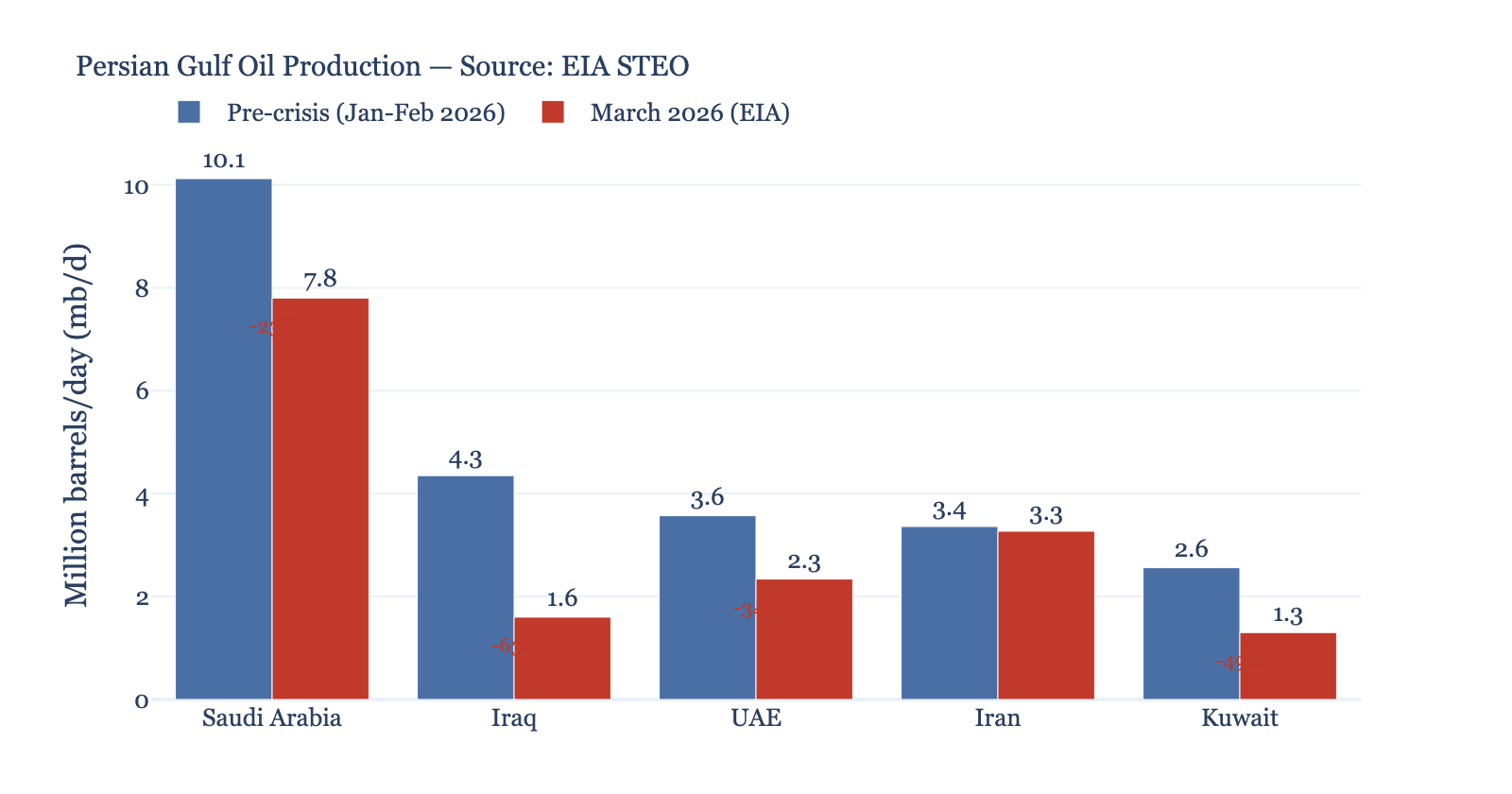
    The Persian Gulf has lost 7.6 million barrels per day of production —

    and 22 million more remain trapped behind the Strait of Hormuz.

    The numbers markets don’t see yet

    One month into the crisis, data from the EIA (US Department of Energy)

    confirms what oil prices are only beginning to reflect.

    Persian Gulf oil production — EIA

    Source: EIA Short-Term Energy Outlook, April 2026

    Iraq has lost 63% of its production. Kuwait 49%.

    Saudi Arabia, still producing 7.8 mb/d, cannot export most of its crude:

    the Strait of Hormuz is closed.

    Iran, which closed the Strait, has lost only 3% of production.

    Whoever holds the key to the passage doesn’t suffer from the blockade.

    Two blackmails, one structure

    The Hormuz crisis is a physical blackmail: 22 million barrels per day

    of blocked transit. It costs nothing to maintain — just don’t open the Strait.

    Whoever controls the passage dictates the terms.

    On the other side of the world, American tariffs are a financial blackmail:

    those who don’t accept the conditions get excluded from the dollar system.

    It costs little to impose — tariffs are paid by consumers in the short term,

    but restructure value chains in the long term.

    The symmetry is instructive. In both cases, the “free world market” reveals

    what it has always been: a system of controlled chokepoints

    — physical and financial — where whoever holds the key dictates terms.

    Hormuz and the dollar are the same thing: bottlenecks.

    What comes next

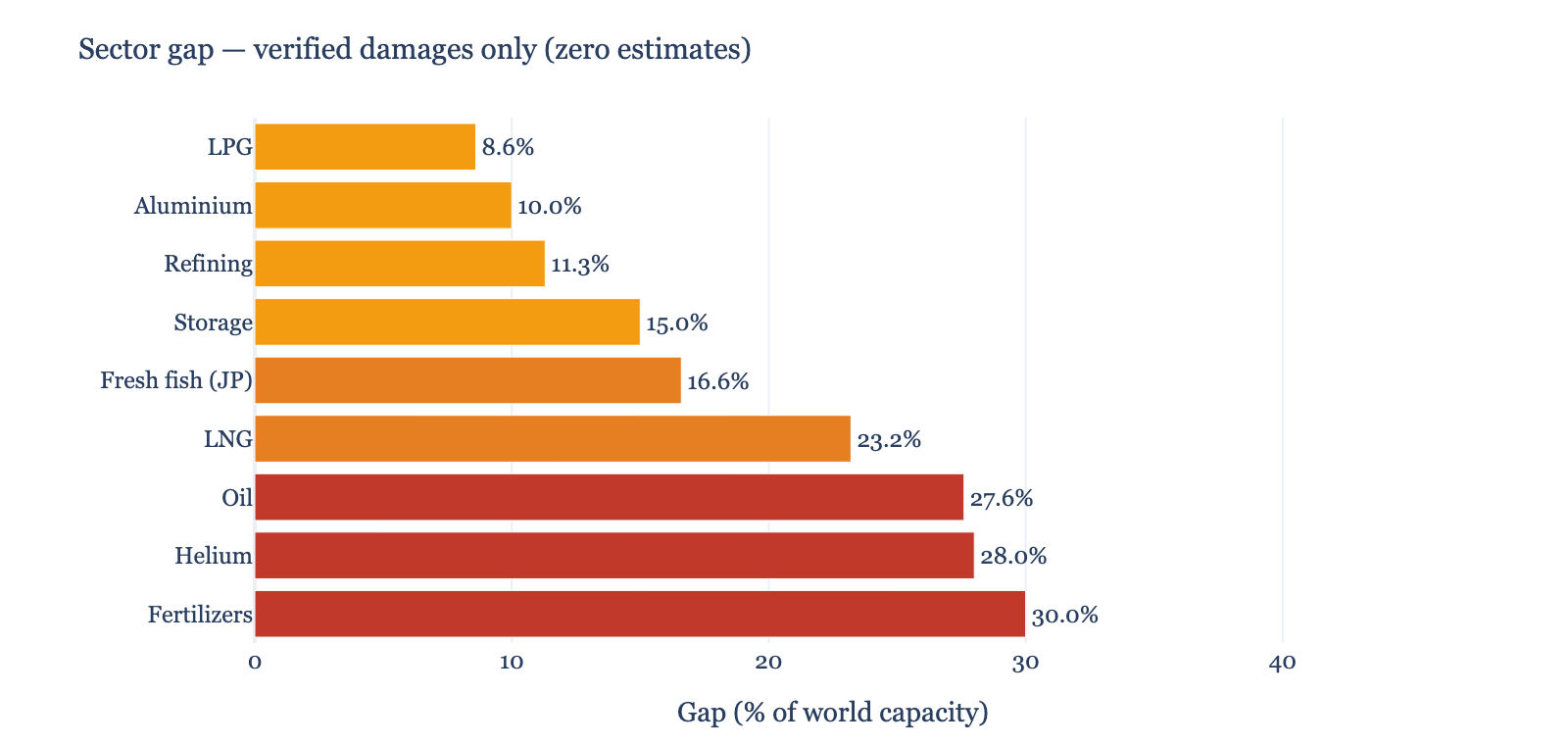
    Sector gaps from verified damages

    Gaps calculated from verified damages (68 events, 7 with quantified impact)

    Sector gaps are calculated exclusively from verified damages:

    27.6% of world oil, 23.2% of LNG,

    30% of global fertilizers. Not estimates — physically destroyed or blocked capacity.

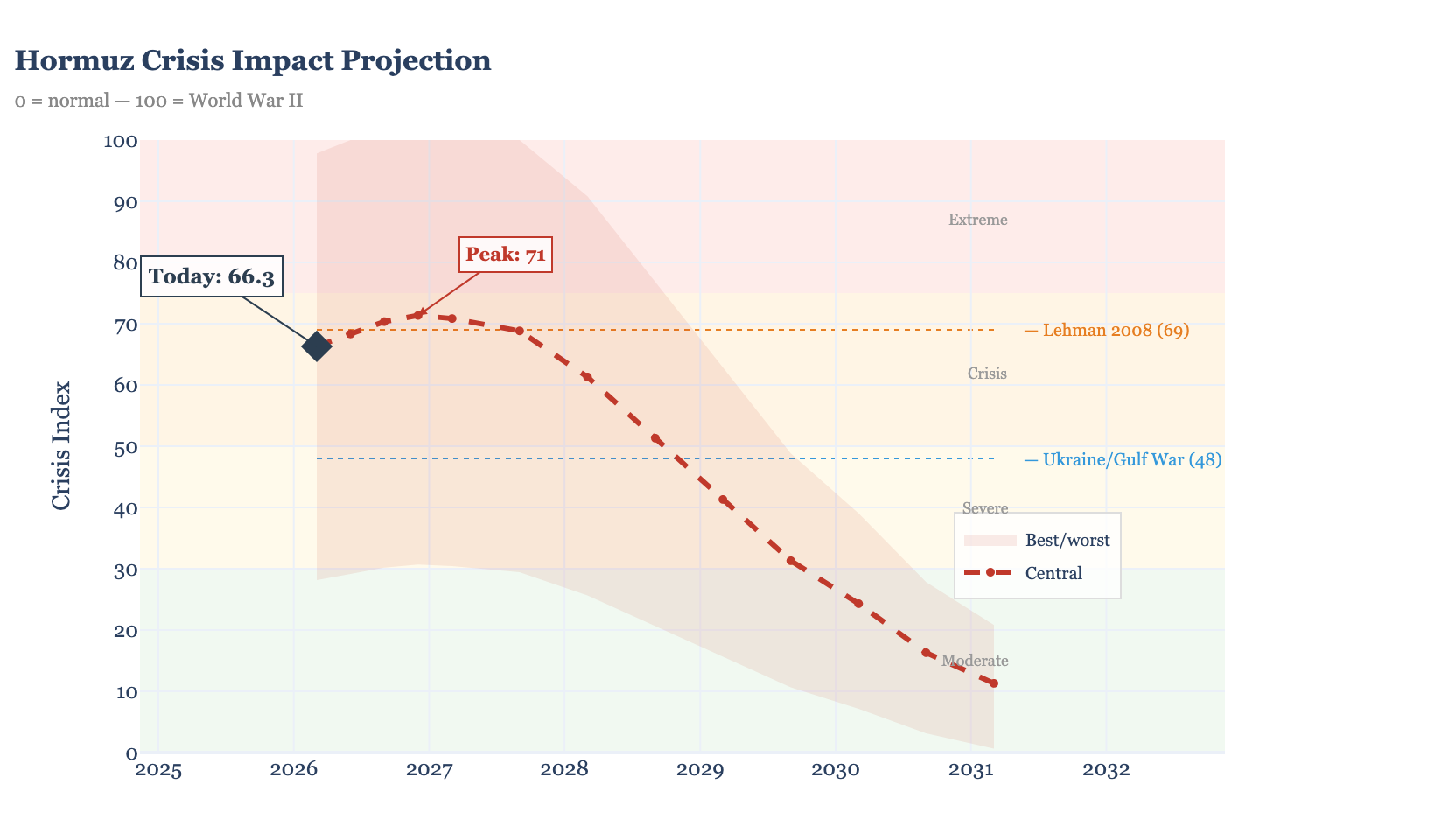
    With current damages alone and no new events,

    the central projection brings the crisis index to 71 by December 2026.

    Not because something new happens, but because the inertia of the energy shock

    takes 6-9 months to reach food and industrial prices.

    Hormuz crisis impact projection

    WW2 scale: 100 = World War II. Current GCI 66.3 — near Lehman (69)

    Stock markets, meanwhile, have rallied. The S&P 500 is above its 250-day moving average

    with VIX at 21. Markets price yesterday’s earnings and today’s rates.

    Tomorrow’s energy and food haven’t arrived yet.

    Can Russia compensate?

    No. EIA data shows Russia stable at 9.1 mb/d — no increase since March.

    It is already at maximum exportable capacity with existing infrastructure.

    Substitution will come from strategic reserves (SPR, 6 months),

    demand destruction, and in 12-24 months, US shale.

    Verified damage timeline

    The registry documents 68 verified events dal 1° marzo 2026,
    of which 13 with quantified capacity impact and 34 attacks on commercial vessels.

    Energy infrastructure

    Date Target Detail Impact
    2026-03-04 🔴 Stretto di Hormuz Iran dichiara chiusura dopo strikes USA-Israele (Khamenei ucciso 28 fe 22.0 mb/d
    2026-03-04 🟡 Iraq produzione petrolifera Produzione -70%: da 4.3 a 1.3 mb/d 3.0 mb/d
    2026-03-04 🟠 Dubai International Airport and Abu Dhabi Dubai e Abu Dhabi hanno subito danni da attacchi iraniani a infrastrut
    2026-03-04 🟠 Kuwait Aerei in Kuwait sono stati messi a terra dopo colpi agli aeroporti
    2026-03-05 🟠 Naphta terminal at the port of Kharg island
    2026-03-08 🟠 Saudi Aramco’s Abqaiq processing facility
    2026-03-09 🟠 Bahrain — Al Ma’ameer (Bapco) Complesso petrolifero colpito, incendio, Bapco dichiara force majeure 267K bpd
    2026-03-09 🟠 Port of Fujairah
    2026-03-10 🟠 Ras Laffan (Qatar LNG) — 2 treni LNG Missili su 2 treni LNG — 12.8 mtpa capacita’ danneggiata, 17% export Q 12.8 mtpa LNG
    2026-03-10 🟠 Ras Laffan (Qatar) — Pearl GTL Impianto Gas-to-Liquids colpito separatamente, danni estesi
    2026-03-10 🟠 Qatari Energy giant QatarEnergy’s oil facilit
    2026-03-11 🟠 Qaem Ensam Oil Refinery
    2026-03-14 🟠 Fujairah Oil Terminal (UAE) Drone — 3 tank distrutti (satellite confermato), ~3M bbl capacita’ sto
    2026-03-15 🟡 Bab al-Mandeb Attacchi Houthi intensificati — bypass Yanbu non affidabile 2.6 mb/d
    2026-03-15 🟠 QatarEnergy Dichiarazione di forza maggiore su tutte le esportazioni di LNG
    2026-03-16 🟠 South Pars oil field
    2026-03-17 🟠 Kuwait and Qatar Attacchi iraniani a impianti di dissalazione, fonte del 99% dell’acqua
    2026-03-18 🟠 Qatar’s inactive Ras Laffan Industrial City L Hit, causing 17% reduction in LNG production capacity. Repair estimate
    2026-03-18 🟠 Kharg Island Oil Terminal
    2026-03-20 🟠 Kuwait — Raffineria Al-Ahmadi Drone strikes — incendi in unita’ operative 200K bpd
    2026-03-26 🟠 Qatar — Ras Laffan Industrial City LNG comple Iranian missile strikes damage Ras Laffan Industrial City LNG complex
    2026-03-29 🟠 UAE Abu Dhabi — EGA Alluminio + Bahrain Alba IRGC attacca impianti alluminio UAE+Bahrain. EGA Abu Dhabi danni signi
    2026-03-30 🟠 Kuwait — Impianto dissalazione + centrale Attacco iraniano su impianto dissalazione acqua + centrale elettrica.
    2026-04-02 🟠 Saudi Arabia – oil field in Ras Al Khair Saudi oil field damaged in Ras Al Khair
    2026-04-03 🟠 Kuwait — Raffineria + Dissalazione (2o attacc Secondo attacco su raffineria Al-Ahmadi + impianto dissalazione. Confe 100K bpd
    2026-04-07 🟠 Hormuz Strait, commercial shipping Failed UN resolution aimed at protecting commercial shipping
    2026-04-08 🟠 East-West oil pipeline, Saudi Arabia Pipeline hit in Iranian attack
    2026-04-09 🟠 Port of Dubai, UAE — Al Salmi Danni al container port e al terminal

    Attacks on commercial vessels

    34 vessels struck in the Strait and Persian Gulf.
    Almeno 5 sunk or abandoned with crew casualties.
    Tankers, container ships, tugs, LNG carriers.
    The full list includes: MT Skylight north of Khasab, MKD VYOM, LCT Ayeh, MT Hercules Star, Ocean Electra, Stena Imperative, Athe Nova, Gold Oak, Libra Trader, Safeen Prestige, Sonangol Namibe, Mussafah 2 (Tugboat), Arabia III – Arabian Gulf, Louise P, Express Rome, One Majesty, MV Mayuree Naree, Star Gwyneth, Safesea Vishnu, Zefyros.

    🔴 Ongoing   🟠 Damaged   🟡 Disrupted.
    Registry auto-updated from 9 OSINT sources (gCaptain, ISW, CSIS, UKMTO, Wikipedia)
    with LLM verification and geographic quality filter.

    Who pays — and how much

    If the Hormuz blockade persists, the impact will not be uniform.
    The estimates below are conditional projections: they assume the current blockade
    continues with no new events and no reopening of the Strait.

    Country/Region Hormuz Dependency Expected impact 6-12 months
    Japan 88% oil Released 80M bbl SPR (45 days). Coal from Australia. Investing in Alaska.
    Iran offered transit to Japanese ships — Tokyo officially declined (US pressure).
    Gasoline +31%, fish -30% supply, kerosene +29%.
    South Korea 75% oil Same structure as Japan, fewer strategic reserves. Nuclear acceleration.
    India 60% oil 90-day reserves. Partial wheat/rice self-sufficiency. Increased Russian imports.
    But fertilizers +40% — kharif 2026 harvest at risk.
    Egypt Fertilizers Urea from $490 to $700/t (+28%). Shifted from gas exporter to net importer.
    Imported wheat vulnerable. Bread subsidy under fiscal pressure.
    Sub-Saharan Africa 80% fert. imports WFP estimates 45 million additional people facing acute hunger if the blockade
    lasts through June. Fertilizers unreachable during planting season.
    Sudan, Kenya, Somalia worst hit.
    Bangladesh/Pakistan 55% oil, 70% fert. Simultaneous currency + energy + food crisis. Rice +12%.
    Political instability risk.
    EU/Europe 15% oil Gas via pipeline (Norway, residual Russia). SPR reserves. CAP agricultural policy.
    Moderate food inflation (+5-8%). Indirect impact: migration pressure
    from Africa and Middle East if food crisis materializes.
    USA 5% oil Energy self-sufficient. Food surplus. SPR 700M bbl.
    Near-zero impact on domestic consumption.

    Conditional estimates assuming current blockade persists.
    Sources: EIA STEO, FAO, WFP, Carnegie Endowment, CFR.
    One third of globally traded fertilizers transit through Hormuz (FAO).

    Sources: EIA Short-Term Energy Outlook (api.eia.gov),

    verified damage registry (68 events, 13 with quantified impact),

    GPR Index (Caldara-Iacoviello, Federal Reserve),

    e-Stat Japan, Yahoo Finance.

    All data and projections derived from publicly verifiable sources.

    Price projections assume persistence of current damages with no new events.

  • When Ceasefires Contradict Themselves

    The point

    A two-week ceasefire announced between the US and Iran is already fracturing along its own internal contradictions. Iran has remined the Strait of Hormuz while issuing navigation charts to avoid its own mines—signaling control while claiming cooperation. Israeli strikes killed over 250 in Lebanon, testing whether Hezbollah falls under the truce’s ambiguous scope. The contradiction is structural: both sides need the pause but cannot abandon the positions that made war inevitable. Markets price energy crisis extension; diplomatic theater masks deeper resource competition.

    Themes of the day

    The Strait Gambit: Control Through Cooperation

    Iran’s Revolutionary Guard published detailed maritime charts showing mine locations in the Strait of Hormuz—a peculiar gesture for a nation supposedly observing ceasefire (Middle East Eye). The message reads clearly: we control this chokepoint and will dictate terms of passage. Ships must “coordinate” with Iranian forces, transforming every tanker into a supplicant.

    This isn’t cooperation but institutionalized leverage. The strait carries 21% of global petroleum liquids; Iran has weaponized geography itself. Energy prices responded immediately—crude reversing Wednesday’s sharp falls as markets grasped the fragility (BBC). European aviation regulators extended Middle East airspace warnings until April 24th, acknowledging the theater remains active combat zone.

    The Trump administration faces the contradiction it negotiated: Iran keeps the strait “technically” open while exercising veto power over every vessel. The ceasefire preserves Iranian strategic advantage while giving Washington political cover. Both sides get what they need temporarily—time to reposition.

    Lebanon’s Exclusion Problem

    Israeli forces killed over 250 Hezbollah fighters in Lebanon Wednesday, the largest single-day toll of the conflict (New York Times). European diplomats scrambled to “include Lebanon in the ceasefire”—revealing the agreement’s deliberate ambiguity about Iran’s regional proxies.

    Iran claims Hezbollah falls under the truce; Israel clearly disagrees. This isn’t miscommunication but calculated room for interpretation. Israel needs to degrade Iranian proxy capabilities while the window remains open. Iran must appear to protect its assets without triggering full escalation.

    The contradiction exposes deeper structural tensions: Iran’s regional influence operates through proxies Washington cannot directly negotiate with. Every Israeli strike in Lebanon tests the ceasefire’s boundaries while serving tactical objectives. The arrangement was designed with this flexibility—both sides knew enforcement would require constant renegotiation of scope.

    Economy & Markets

    Energy markets reversed Wednesday’s optimism as Hormuz closure reality set in. Brent crude gained 4.2% in early Asian trading; European gas futures jumped 8% (financial data unavailable for specific figures). Italian energy agency ENEA reports gas prices up 70% from 2022 levels, electricity costs doubled—with Iran war impact adding 0.4% drag on EU growth, potentially 0.6% if conflict extends (ANSA).

    The European Commission’s Dombrovskis warns of stagflation risk, floating coordinated EU windfall profit taxes on energy companies. Capital flows reveal the underlying tension: wealthy investors attempted $20 billion in withdrawals from private credit funds as uncertainty mounted (Financial Times). Markets price continued energy volatility regardless of diplomatic pauses.

    Dollar weakness (referenced in [RAG-1]) typically supports equity returns, but energy shock dynamics override standard correlations during supply crisis periods.

    Weak signals

    North Korea’s war laboratory: Pyongyang accelerated weapons testing, explicitly drawing lessons from Iran conflict dynamics (NYT). The hermit kingdom treats every international conflict as R&D opportunity—Ukraine war informed missile development, now Middle East crisis shapes nuclear doctrine.

    Argentina’s glacier mining: Congress approved mining in protected glacier areas despite mass protests (Al Jazeera). Lithium and rare earth demand from energy transition creates pressure to exploit previously untouchable reserves. Climate crisis solutions generate new resource extraction imperatives.

    Vietnam trafficking networks: European police dismantled Vietnam-UK smuggling operation earning €3 million annually (Straits Times). Migration flows respond to economic disruption; war-driven inflation accelerates movement toward stable currency zones.

    Key takeaway

    The ceasefire’s contradictions aren’t bugs but features. Both sides needed breathing space to consolidate positions while maintaining maximum flexibility for next moves. Iran keeps its chokepoint leverage; Israel continues proxy degradation; Washington claims diplomatic progress. The arrangement acknowledges that underlying resource competition cannot be resolved through temporary truces. Watch how long economic pressures allow this tactical pause to hold.

    Worth reading

    This publication provides analysis and information for educational purposes only. It does not constitute investment advice, a personal recommendation, or an offer to buy or sell any financial instrument. The author is not a registered investment advisor. Past statistical patterns do not guarantee future results.

    Orizzonti Quotidiani — For the Future | orizzonti.news

    09 April 2026 — 20:03 JST · 13:03 CEST · 07:03 EST

  • The Strait’s Toll

    Iran threatens to charge ships $2 million for Hormuz passage while Israeli strikes on Lebanon test a fragile ceasefire — showing how chokepoint control shapes diplomatic leverage when empire contracts.

    The Point

    Tehran proposes monetizing the Strait of Hormuz as part of its ceasefire terms with Washington, demanding up to $2 million per vessel to fund reconstruction. Meanwhile, Israel pounds Lebanon with its heaviest strikes yet, killing 254 people and exposing contradictory interpretations of the truce boundaries. These aren’t separate crises but expressions of the same structural tension: declining American hegemony creates openings for regional powers to extract tribute from global commerce, while client states test the limits of imperial protection. The chokepoint becomes both weapon and revenue stream.

    Themes of the Day

    Maritime Tribute in the New Disorder

    Iran’s demand for Hormuz passage fees crystallizes how strategic geography converts to economic leverage when superpower control weakens [5]. Tehran calculates that 30% of global oil flows through waters it can credibly threaten, transforming reconstruction needs into a toll collection scheme. The $2 million figure signals not desperation but confidence — high enough to fund infrastructure rebuilding, low enough to remain cheaper than alternative routes.

    Singapore’s refusal to negotiate draws Malaysian backlash, revealing how the tribute demand splits even close allies [31]. Kuala Lumpur sees negotiation as pragmatic; Singapore frames it as capitulation to extortion. Both positions reflect their different exposure levels: Malaysia imports more Middle Eastern energy, Singapore controls alternative financial flows. The friction shows how chokepoint economics fractures alliance structures when imperial guarantees weaken.

    Trump’s 50% tariff threat against Iran’s weapons suppliers attempts to reassert control through trade punishment [33]. But the mechanism reveals limitation — American leverage now operates primarily through market access, not direct force projection. Countries must choose between Iranian energy access and American market entry, a choice that becomes harder as energy prices climb and reconstruction demand grows.

    Client State Testing Boundaries

    Israel’s massive Lebanon strikes occur precisely as US-Iran talks begin in Pakistan, testing whether American protection covers expanded definitions of “security operations” [34]. The timing isn’t coincidental — Netanyahu’s government probes how far it can stretch ceasefire terms while Washington needs to show diplomatic progress. Each bomb tests whether Israeli actions can torpedo American negotiations.

    The contradiction centers on Lebanon’s inclusion in the truce. Iran claims Lebanese territory falls under the agreement; Israel interprets it as bilateral US-Iran only [1]. This isn’t legal ambiguity but structural logic — client states always push for maximum operational freedom while patrons seek maximum diplomatic flexibility. The 254 death toll measures how far that testing can go before triggering wider escalation.

    Trump’s threat to resume “bigger and better” attacks if Iran violates terms attempts to constrain both Tehran and Tel Aviv [39]. But the formula exposes the bind: threatening Iran too harshly encourages Israeli maximalism, while restraining Israel too visibly signals American weakness to regional competitors. The contradiction deepens as energy markets price in both ceasefire collapse and maritime disruption.

    Great Power Competition Through Regional Proxies

    China’s military “purification” campaign under Xi Jinping reflects preparation for prolonged competition as American attention splits between multiple theaters [17]. The PLA centenary preparations coincide with Taiwan opposition leader visits to Beijing [20], signaling coordination between internal reorganization and external pressure campaigns. Beijing calculates that American resources stretched across Iran, Ukraine, and domestic crises create windows for fait accompli scenarios.

    North Korea’s cluster-bomb warhead tests provide covering action for Chinese positioning, forcing American defensive resources toward the peninsula while Beijing consolidates South China Sea control [6]. Pyongyang’s weapons development serves Chinese strategic interests by multiplying American response requirements. Each missile test requires American surveillance and defensive positioning that cannot simultaneously monitor Taiwan approaches.

    The [RAG-1,RAG-2] strategic competition framework shows how regional conflicts become proxy competitions for global influence. Iran’s chokepoint control serves Chinese interests by demonstrating American inability to guarantee global commons access, while Israeli actions test whether American allies can operate independently of superpower diplomatic initiatives.

    Economy & Markets

    Energy futures spike on Hormuz toll uncertainty, with Brent crude adding $3.40 to close at $89.60 (Financial Times). European markets price in prolonged energy crisis as alternatives to Hormuz routing remain limited. Natural gas futures surge 8% on supply disruption fears.

    Credit markets show strain as private equity redemption requests accelerate (Financial Times). Institutional investors pull capital from illiquid investments as geopolitical uncertainty demands cash positioning. High-yield spreads widen 45 basis points as war premium gets repriced across risk assets.

    Asian shipping rates climb 15% on routing uncertainty, with alternative Suez passages already congested. Container throughput at Singapore ports increases 12% as trans-shipment demand shifts from Gulf terminals.

    Weak Signals

    Military recruitment as economic indicator: Thailand sees voluntary enlistment rise for five consecutive years, driven by economic malaise rather than patriotism [12]. Young men choose military service as employment substitute when civilian opportunities contract. Pattern suggests broader regional economic stress not captured in aggregate GDP figures.

    Scam compound closures: Despite large-scale law enforcement operations, Southeast Asian fraud centers relocate rather than shut down entirely [2]. Criminal networks adapt faster than regulatory responses, indicating governance gaps in rapidly developing regions under economic pressure.

    Infrastructure vulnerability cascades: Hong Kong’s brief voltage dip traps 90 people in elevators simultaneously [40]. Single points of failure in urban systems create wider disruption as population density increases. Pattern suggests infrastructure investment lagging behind urbanization demands across Asian growth centers.

    Key Takeaway

    Chokepoint control becomes both weapon and revenue stream as American hegemonic decline creates arbitrage opportunities for regional powers. Iran’s Hormuz toll demand and Israeli boundary testing represent different faces of the same phenomenon — client and competitor states exploiting superpower overstretch to expand their operational freedom. Tomorrow, watch whether American diplomatic responses can contain both challenges simultaneously, or whether managing one crisis enables escalation in the other.

    Worth Reading

    This publication provides analysis and information for educational purposes only. It does not constitute investment advice, a personal recommendation, or an offer to buy or sell any financial instrument. The author is not a registered investment advisor. Past statistical patterns do not guarantee future results.

    Orizzonti Quotidiani — For the Future | orizzonti.news

    09 April 2026 — 14:33 JST · 07:33 CEST · 01:33 EST

  • The Ceasefire That Divides to Conquer

    The point

    A 24-hour-old US-Iran ceasefire fractures along its most obvious fault line: Lebanon. While Tehran claims Hezbollah was included, Washington explicitly excludes it, allowing Israel to kill 254 people across Lebanon while oil crashes 16% on ceasefire hopes. The contradiction reveals itself immediately—not in the deal’s terms, but in who benefits from the confusion. Trump secures breathing space to claim victory while maintaining maximum pressure, Iran halts immediate devastation while preserving proxy leverage, and Israel continues its regional campaign under ceasefire cover. The pause serves each power’s tactical needs while resolving none of the structural tensions that produced the war.

    Themes of the day

    **The Lebanon Loophole: Strategic Ambiguity as Policy**

    The ceasefire’s central contradiction crystallized within hours. Iran’s parliament speaker insists Lebanon was included; VP Vance flatly denies this [3]. The result: Israel launches massive strikes killing over 254 across Lebanon [6,17], while Iran halts oil tanker passage through Hormuz in response [14].

    This isn’t diplomatic confusion—it’s deliberate architecture. Trump’s team, which brokered the deal through Pakistan [23], needed face-saving space after five weeks of inconclusive war [13]. Iran needed to stop the devastation of its infrastructure while maintaining Hezbollah as leverage. Israel required freedom to continue its regional campaign while America de-escalates.

    The ambiguity serves all parties tactically. Trump can claim he ended the Iran war while Israel continues operations. Iran can preserve its proxy network while halting direct strikes on its territory. The contradiction will discharge when one side’s tactical needs shift—likely when domestic pressure forces clarification.

    **Victory Theater Amid Strategic Stalemate**

    All sides rush to declare triumph in a war that resolved none of its underlying drivers [12,21]. Trump administration claims to have “met and exceeded” military objectives [13] despite Iran’s nuclear program advancing and regional proxy network intact. Iranian officials celebrate survival while acknowledging infrastructure damage [4]. Netanyahu vows readiness to “return to battle at any moment” [17].

    The material scorecard tells a different story. US combat forces remain in the region despite Iranian demands for withdrawal [32]. The nuclear enrichment “red line” persists [31]. Iran’s oil exports face continued sanctions pressure. Israel’s regional security concerns remain unaddressed. China emerges as the clearest winner, having mediated the ceasefire while positioning itself as the responsible great power [36].

    Market reactions capture the reality: oil plunges 16.4% to $94.41 [30] on temporary supply relief, but Fed minutes show officials braced for sustained inflationary pressure [27], signaling expectations that this pause won’t hold.

    **NATO’s Failure and European Rearmament Acceleration**

    The White House’s blunt assessment that NATO “failed to back war on Iran” [9] exposes the alliance’s structural limits when American interests diverge from European calculations. France’s immediate response: €36 billion in additional defense spending through 2030, expanding nuclear arsenal and missile stocks [10].

    This marks a qualitative shift in European strategic autonomy [RAG-6]. When Washington pursues unilateral military action that threatens European energy security and economic stability, the transatlantic bond reveals its conditional nature. France’s rearmament program signals preparation for scenarios where American and European interests fundamentally diverge.

    The timing is precise: as American attention turns inward and NATO proves inadequate for managing great power competition, European capitals accelerate military capacity building. The Iran war has accelerated what Ukraine began—Europe’s recognition that strategic dependence on American decision-making carries unacceptable risks.

    Economy & Markets

    Oil futures collapse 16.4% to $94.41 on ceasefire news [30], while Fed officials prepare for sustained inflation from Middle East conflict [27]. SEC appoints Gibson Dunn’s David Woodcock to enforcement, signaling accelerated financial deregulation [8]. UK National Wealth Fund faces losses on Gigaclear broadband guarantee as lenders take control [37]. Latin America growth slows to 2.1% in 2026, with Brazil and Mexico failing to provide regional momentum [34].

    Energy markets reflect temporary supply relief rather than structural resolution. The Strait of Hormuz remains contested [5,32], Iranian production capacity damaged but not eliminated, and Gulf infrastructure vulnerable to renewed strikes [32]. Financial markets price tactical pause, not strategic settlement.

    Weak signals

    Greece moves to ban social media for children under 15 [38], following Australia’s lead in state control over digital platforms. Canada’s Mark Carney positioned to secure Liberal majority after defections [20], potentially reshaping North American political alignment. Gambia appoints British barrister to prosecute Jammeh-era crimes [18], extending post-colonial justice mechanisms into former strongman territories.

    Key takeaway

    The US-Iran ceasefire succeeds precisely because it resolves nothing fundamental while serving each power’s immediate tactical needs. Trump secures domestic political space, Iran halts infrastructure destruction, Israel continues regional operations. The Lebanon ambiguity isn’t a flaw—it’s the feature that makes temporary accommodation possible. Watch for the contradiction to discharge when domestic pressures force clarification, likely within weeks rather than months.

    Worth reading

    This publication provides analysis and information for educational purposes only. It does not constitute investment advice, a personal recommendation, or an offer to buy or sell any financial instrument. The author is not a registered investment advisor. Past statistical patterns do not guarantee future results.

    *Orizzonti Quotidiani — For the Future | orizzonti.news

    09 April 2026 — 05:01 JST · 22:01 CEST · 16:01 EST*

  • Tehran’s Temporary Reprieve Meets Capital’s Calculated Relief

    The point

    The US-Iran ceasefire reveals not peace but the material limits of war economies. Two weeks to negotiate while oil flows resume and equity markets surge—a pause dictated by energy infrastructure strain, not diplomacy. Israel immediately clarifies the truce excludes Lebanon, exposing the fragmented nature of proxy conflicts when core interests diverge. Markets respond to supply chain restoration, not hope.

    Themes of the day

    Energy Chokepoints Drive Ceasefire Calculations

    Iran’s month-long closure of the Strait of Hormuz—carrying 21% of global petroleum liquids—has demonstrated the material foundation of geopolitical leverage [10]. Thailand confirms three cargo crew deaths from Iranian attacks during the blockade, underlining how energy route control translates to lethal force projection. The ceasefire coincides with European equity surges: Milan +3.9%, led by energy-exposed Unicredit and auto manufacturer Stellantis (ANSA).

    Exxon reports a $6.5bn first-quarter hit from the Iran conflict, though hedging mechanisms mask immediate gains (Financial Times). The accounting reveals how energy majors structure exposure to geopolitical risk—anticipating disruption through derivatives that socialize costs while privatizing eventual benefits. China’s PLA conducts nuclear decontamination exercises facing the Taiwan Strait, simulating responses to US-Israeli targeting of Iranian nuclear facilities [38]. The military preparation acknowledges that energy wars carry nuclear escalation potential.

    Trump’s threat to “destroy Iran’s whole civilization” hours before the ceasefire exposes the contradiction: maximum pressure rhetoric preceding tactical retreat driven by energy market constraints.

    Proxy War Fragmentation Under Economic Pressure

    Israel’s immediate resumption of Lebanon strikes while accepting the Iran truce reveals how proxy conflicts operate under distinct material logics [19, 27]. Netanyahu’s government represents settlement capital and defense contractors whose interests diverge from US energy concerns. Hezbollah urges displaced Lebanese not to return home, anticipating continued bombardment despite ceasefire announcements [32].

    The asymmetry is structural: Iran controls energy chokepoints worth hundreds of billions annually, while Hezbollah represents demographic-territorial control worth billions in reconstruction contracts and regional influence. France secures release of two nationals held in Iran for espionage, claiming no connection to the broader ceasefire—yet the timing reveals how hostage diplomacy operates within larger strategic calculations [14, 17].

    Turkey’s Erdogan warns against ceasefire provocations while Hungary deepens economic ties with Russia, showing how regional powers maneuver between competing blocs based on energy dependencies and capital flows [21, 24].

    Economy & Markets

    European markets surge on ceasefire news: Milan +3.9% led by banking (Unicredit) and manufacturing (Stellantis) sectors most exposed to energy price volatility. BTP-Bund spread tightens to 76bp, reflecting reduced inflation expectations from oil price stabilization.

    Delta Airlines reports Q1 revenues up to $14.2bn despite $289mn net loss, projecting $1bn June profit as energy costs moderate. The aviation sector’s recovery timeline directly tracks petroleum price trajectories.

    USD weakness (indicated in knowledge base [RAG-1]) typically supports equity forward returns, compounding the relief rally from energy supply restoration.

    Weak signals

    Greece bans social media for under-15s starting 2027, following France and Spain—technology governance fragmenting along national lines as digital platform revenues face regulatory pressure [11].

    Japan’s former PM Ishiba meets South Korean president to expand economic cooperation, suggesting Pacific alliance deepening while Atlantic partnerships strain under energy crisis [23].

    Hong Kong Easter box office doubles year-over-year to HK$25.93mn despite population outflows, indicating cultural consumption resilience amid demographic transition [33].

    Key takeaway

    The ceasefire masks deeper contradictions: Iran retains chokepoint control, Israel maintains proxy war autonomy, and energy markets dictate diplomatic timing. The two-week pause allows inventory rebuilding and price normalization, but underlying structural tensions—US-Iran competition for Middle East energy control, Israeli settlement expansion, proxy network fragmentation—remain unresolved. Watch oil futures and regional military positioning for durability signals.

    Worth reading

    This publication provides analysis and information for educational purposes only. It does not constitute investment advice, a personal recommendation, or an offer to buy or sell any financial instrument. The author is not a registered investment advisor. Past statistical patterns do not guarantee future results.

    Orizzonti Quotidiani — For the Future | orizzonti.news

    *Orizzonti Quotidiani — For the Future | orizzonti.news*
    *08 April 2026 — 21:00 JST · 14:00 CEST · 08:00 EST*

  • Il prezzo della pace: quando l’impero negozia con il fucile spianato

    Il punto

    Trump annuncia una tregua di due settimane con l’Iran, ore prima della scadenza del suo ultimatum di “distruggere un’intera civiltà”. Il cessate il fuoco, mediato dal Pakistan, riapre lo Stretto di Hormuz in cambio di colloqui a Islamabad. I mercati festeggiano: petrolio giù del 20%, Tokyo vola di 2800 punti. Ma questa “vittoria” rivela quanto precario sia diventato l’equilibrio globale quando la prima potenza mondiale deve negoziare dopo aver minacciato il genocidio.

    Temi del giorno

    La diplomazia delle minacce estreme

    L’accordo USA-Iran (Al Jazeera) porta la firma del Pakistan come mediatore — dettaglio che ridimensiona il ruolo americano in Asia meridionale. Trump aveva dato 24 ore all’Iran per riaprire Hormuz “o una civiltà intera sarebbe morta stanotte” (Japan Times). L’Iran rivendica una “vittoria storica” sostenendo che Washington ha accettato i suoi 10 punti negoziali (Middle East Eye).

    La sequenza è rivelatrice: prima l’ultimatum apocalittico, poi la mediazione pakistana, infine i negoziati programmati a Islamabad. Gli Stati Uniti mantengono la supremazia militare ma perdono l’egemonia diplomatica. Perfino Papa Leone XIV — primo pontefice americano della storia — ha definito le minacce di Trump “veramente inaccettabili” (New York Times).

    Il controllo di Hormuz vale il 40% delle esportazioni mondiali di petrolio greggio. L’Iran ha dimostrato di poter chiudere lo Stretto anche sotto pressione militare estrema, costringendo Washington a negoziare.

    I mercati traducono la geopolitica

    Il petrolio WTI crolla a 91 dollari, perdendo quasi il 20% in poche ore (NHK World). Tokyo registra un balzo di 2800 punti (NHK World). Gli investitori scommettono sulla riapertura delle rotte energetiche, ma la volatilità estrema rivela quanto fragile sia l’architettura economica globale.

    Le compagnie filippine sospendono i voli verso il Medio Oriente (Straits Times) — sintomo di un’economia asiatica ormai dipendente dalle rimesse dei lavoratori nella regione petrolifera. La finanziarizzazione dell’energia tocca anche i call center di Manila: l’instabilità energetica si traduce in costi operativi più alti per le multinazionali.

    L’oscillazione dei prezzi energetici tra guerra e pace mostra come il capitale globale dipenda da equilibri geopolitici sempre più instabili. Due settimane di tregua bastano a scatenare euforia sui mercati — segno di un sistema nervoso.

    L’Asia riorganizza le proprie catene

    Il Vietnam conferma la visita di stato in Cina del presidente To Lam per il 14-17 aprile (Straits Times). Hong Kong accelera lo sviluppo del polo tecnologico di San Tin al confine (SCMP). La Corea del Nord lancia missili a corto raggio nel Mar del Giappone (NHK World) mentre Seoul spera ancora in una ripresa diplomatica.

    Le potenze regionali si muovono indipendentemente dalla crisi USA-Iran. Il Vietnam rafforza i legami con Pechino mentre Washington è impegnata in Medio Oriente. Hong Kong sviluppa hub tecnologici per ridurre la dipendenza dalle supply chain occidentali. La Corea del Nord mantiene la pressione militare sapendo che l’attenzione americana è altrove.

    L’India importa l’80% di petrolio e gas ma anche le terre rare per la transizione verde (Japan Times) — doppia dipendenza che la espone sia alle crisi energetiche che tecnologiche. L’Asia costruisce alternative mentre l’Occidente gestisce le emergenze.

    Economia & Mercati

    • Petrolio: WTI crolla da 112 a 91 dollari (-18,8%) dopo l’annuncio della tregua
    • Equity: Nikkei +2800 punti (+7,2%), futures europei in forte rialzo
    • Valute: Dollaro stabile, yen si rafforza sui beni rifugio
    • Spread: Treasury a 10 anni scende di 15 basis point a 4,12%

    Segnali deboli

    Il Giappone espelle 318 stranieri senza documenti — record storico (SCMP) che riflette una società sempre più chiusa mentre la demografia implode. L’Australia arresta un ex-soldato per crimini di guerra in Afghanistan (Straits Times), segnale di come i conflitti “conclusi” tornino a casa sotto forma di accountability legale. Le Filippine rischiano di perdere il primato nei call center per carenze nell’alfabetizzazione (Japan Times) — sintomo di sistemi educativi che non reggono la competizione globale.

    Chiave di lettura

    La tregua USA-Iran non è diplomazia: è la prova che l’impero americano deve ormai negoziare sotto ricatto. Due settimane sono niente, ma bastano ai mercati per scommettere su una pace che nessuno può garantire. Il vero vincitore è il Pakistan come mediatore, l’Asia che si riorganizza durante la crisi occidentale.

    Da leggere

    Questa pubblicazione fornisce analisi e informazioni a scopo esclusivamente informativo ed educativo. Non costituisce consulenza finanziaria, raccomandazione personalizzata ne’ offerta di acquisto o vendita di strumenti finanziari. L’autore non e’ un consulente finanziario registrato. Le evidenze statistiche passate non garantiscono risultati futuri.

    Orizzonti Quotidiani — For the Future | orizzonti.news

  • Capitalism pauses for inventory: US-Iran ceasefire secures energy flows while contradictions accumulate

    The point

    The two-week US-Iran ceasefire represents capital’s need to secure energy circulation over geopolitical theater. Trump’s theatrical threats of civilizational annihilation resolved into Pakistan-brokered talks and Strait of Hormuz reopening—precisely what oil markets demanded. Iran claims “historic victory” while accepting negotiations; Trump claims success while stepping back from apocalyptic rhetoric. Both positions mask the material reality: global accumulation requires Persian Gulf oil flows more than either side’s ideological posturing. The pause allows inventory restocking and profit realization, but underlying contradictions between declining US hegemony and rising Persian Gulf autonomy remain unresolved.

    Themes of the day

    Energy security overrides imperial ambitions

    Oil markets delivered the verdict before diplomats spoke. WTI crude plunged 20% to $91/barrel as ceasefire news broke, while Tokyo stocks surged 2,800 points (Nikkei). The Strait of Hormuz—conduit for 20% of global oil—will reopen for “safe navigation” during the truce period, Iranian Foreign Minister Araghchi announced [3]. Philippine carriers immediately resumed Middle East flights, restoring labor migration routes that serve Gulf petrostates [4].

    Pakistan’s mediation role reveals the new geography of influence. While Washington and Tehran postured, Islamabad secured talks scheduled for April 10th—positioning itself as indispensable broker between declining Western hegemony and rising regional powers. The ceasefire terms suggest US acceptance of Iranian regional position: Tehran’s “10-point proposal” was reportedly accepted as negotiation framework [9], marking Washington’s retreat from regime change fantasies toward coexistence management.

    Imperial overstretch meets market discipline

    Trump’s threat to end “a whole civilization” [27] exposed the gap between rhetoric and capacity. The walk-back to negotiated pause reveals how financial markets constrain even superpower behavior when accumulation circuits face disruption. Pope Leo XIV’s condemnation [21] reflected broader European concerns about US reliability, while climate activist Greta Thunberg’s criticism [30] captured generational skepticism toward military solutions.

    The ceasefire allows both sides to claim victory while avoiding material consequences neither could afford. Iran frames the pause as US capitulation to its terms; Washington presents it as successful coercion. Both narratives serve domestic political needs while global capital secured its primary objective: uninterrupted energy flows.

    Economy & Markets

    Markets celebrated the return of predictability. Oil’s 20% intraday collapse reflected oversupply fears once Hormuz blockade lifted. Japanese equities soared on reduced war premium, while global shipping stocks rallied on reopened Persian Gulf routes. The two-week timeline creates artificial urgency for talks while allowing inventory rebuilding and contract renegotiation.

    Energy futures curves flattened as geopolitical risk premium evaporated. The speed of market response—celebrating before diplomatic details emerged—demonstrates how thoroughly economic logic now shapes geopolitical outcomes.

    Weak signals

    North Korea fired multiple short-range ballistic missiles 240km into the Sea of Japan [18], testing regional stability during Middle East de-escalation. Jakarta officials caught using AI-generated images for public complaints [1] signal broader erosion of administrative credibility in Southeast Asian governance. Vietnam’s President To Lam schedules China visit for April 14-17 [31], reinforcing Beijing-Hanoi coordination as Washington focuses on Middle East management.

    Key takeaway

    The ceasefire reveals how market imperatives discipline even superpower ambitions when energy security is threatened. But two weeks only postpones rather than resolves the fundamental contradiction: US global hegemony requires Persian Gulf control that regional powers increasingly reject. Pakistan’s successful mediation signals the emergence of alternative diplomatic circuits bypassing Western institutions. Capital secured its immediate need for oil flow stability, but underlying tensions between imperial decline and resource control remain explosive.

    Worth reading

    This publication provides analysis and information for educational purposes only. It does not constitute investment advice, a personal recommendation, or an offer to buy or sell any financial instrument. The author is not a registered investment advisor. Past statistical patterns do not guarantee future results.

    Orizzonti Quotidiani — For the Future | orizzonti.news